Free Government iPhone in Alabama: Lifeline, EBT, Medicaid and Provider Options
Alabama residents can check free or discounted phone options through Lifeline, but there is no guaranteed federal program that gives every eligible person a free iPhone. iPhone availability depends on provider offers, ZIP code, stock, device condition, shipping, activation rules, and eligibility verification.
Quick answer for Alabama
Lifeline is still active. ACP ended, and households stopped receiving ACP discounts after June 1, 2024. Alabama residents who receive Food Assistance, Medicaid, SSI, housing assistance, certain veterans benefits, or meet income rules may qualify for Lifeline service support. An iPhone is never guaranteed, and many providers offer Android phones more often than iPhones.
Lifeline Free iPhone is an independent informational website. It is not a government agency, phone provider, FCC, USAC, or Apple reseller.
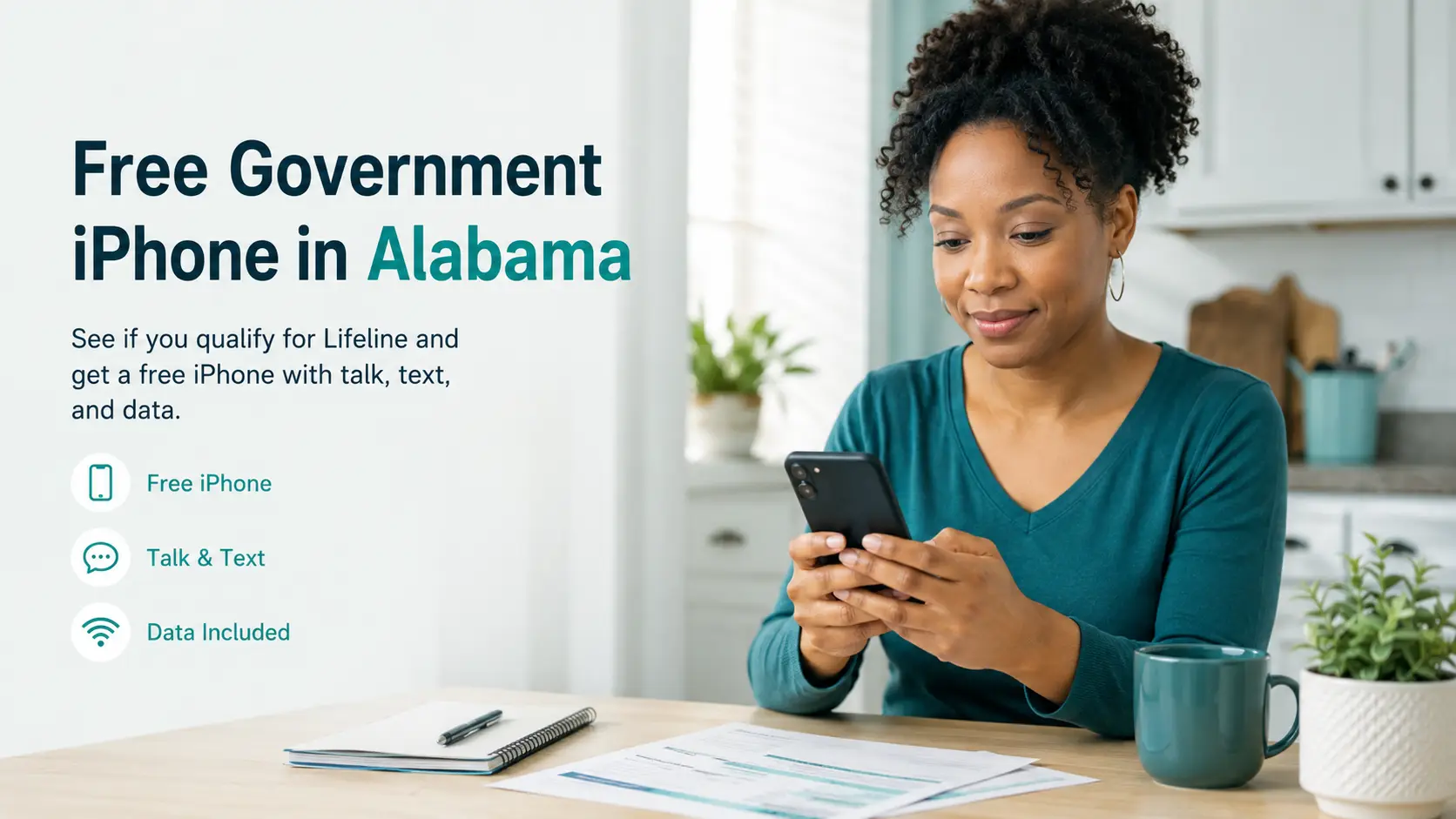
Quick Answer for Alabama Residents
A free government iPhone in Alabama usually means a Lifeline-related phone provider may offer a free or discounted smartphone to eligible customers. The phone might be an Android device, a basic smartphone, a 5G-capable phone, or sometimes a refurbished iPhone when a provider runs a promotion in your ZIP code.
Alabama Food Assistance, Alabama Medicaid, SSI, FPHA or Section 8, Veterans Pension, Survivors Benefit, qualifying Tribal programs, or income at or below Lifeline limits can help prove eligibility. These programs can support your Lifeline eligibility check, but none of them force a provider to hand you an iPhone.
The safest path is pretty simple: confirm your eligibility, use the National Verifier or a provider's official process, search providers by your Alabama ZIP code, compare device terms carefully, and stay away from any website or social media account promising instant iPhone approval.
Important Alabama safety note
Do not give your EBT PIN, bank details, card number, or full sensitive identity details to a random website, Facebook page, WhatsApp agent, or Telegram seller. A real Lifeline process may ask for accepted proof through official or provider channels, but it should never need your EBT PIN.
What "Free Government iPhone" Means in 2026
The phrase "free government iPhone" gets tossed around a lot, and honestly, it can be misleading. Lifeline is a federal benefit that helps eligible households reduce the cost of phone, internet, or bundled service. It is not an iPhone giveaway program.
Some wireless companies that take part in Lifeline may include a phone with service. Which phone you get depends on that company's inventory, the ZIP code you enter, your eligibility result, device condition, activation rules, shipping rules, and any copay or upgrade fee. In Alabama, a resident in Birmingham may see completely different provider options than someone in the Black Belt, the Wiregrass, north Alabama, or the Gulf Coast.
iPhones are usually less common than Android phones in Lifeline-related offers. When an iPhone shows up, it may be refurbished, older, limited stock, part of a short promotion, or only available through one specific provider. Read the device page before you hit submit on any application.
iPhone vs Android expectations
- An iPhone may be limited to certain providers or promotions.
- An Android phone may be the standard free phone option.
- A 5G phone may be available, but 5G coverage depends on network and location.
- A discounted iPhone may require a copay, upgrade fee, or refurbished-device terms.
- Phone offers can change before your application is approved.
Does Alabama Have a Free iPhone Program?
There is no verified official statewide program in Alabama that guarantees a free iPhone to every eligible resident. Treat any "guaranteed iPhone" claim with serious caution, especially if it says the offer comes from the government, asks for payment before approval, or uses fake ACP wording after ACP already ended.
The safer alternatives are Lifeline providers, free or discounted smartphones tied to provider service, official benefit proof, public library internet access, community action support, and state broadband or digital access resources. These can genuinely help you get connected, but none of them promise a specific Apple device.
Main Ways Alabama Residents May Qualify
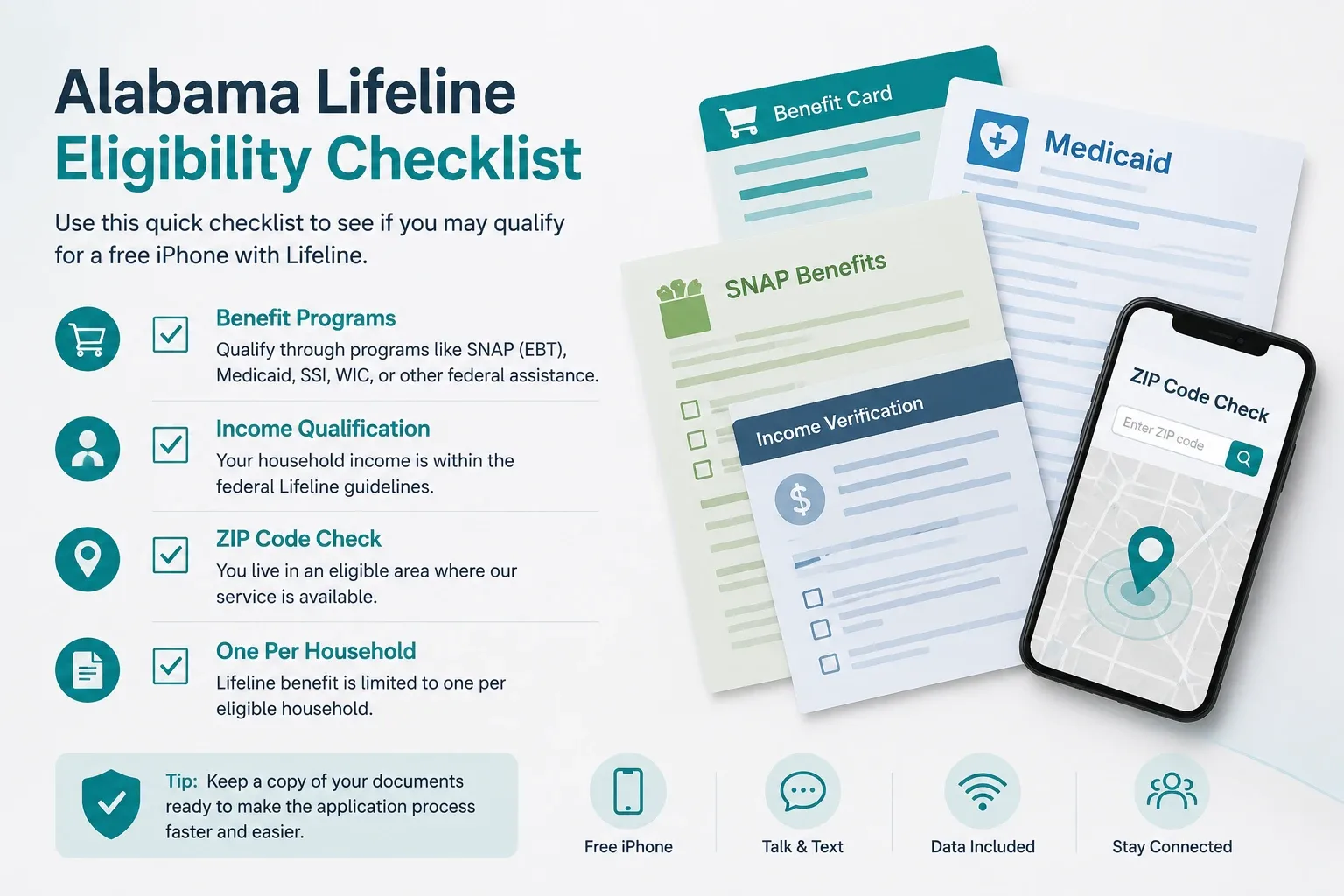
Most Alabama residents who check Lifeline phone options qualify through a benefit program or income. If your eligibility is not confirmed automatically, you may need to upload or submit accepted proof.
| Eligibility route | Alabama example | What it may prove | iPhone impact |
|---|---|---|---|
| SNAP or EBT | Alabama Food Assistance Program through Alabama DHR | Program-based Lifeline eligibility | Can help you qualify for Lifeline, but does not guarantee an iPhone |
| Medicaid | Alabama Medicaid through the Alabama Medicaid Agency | Program-based Lifeline eligibility | Can help prove eligibility, device offer still depends on provider |
| SSI | Supplemental Security Income | Program-based eligibility | May help with service support, not a specific phone model |
| FPHA or Section 8 | Federal Public Housing Assistance | Program-based eligibility | Provider still controls device availability |
| Veterans or survivor benefits | Veterans Pension or Survivors Benefit | Program-based eligibility | May qualify the household for Lifeline |
| Income | Household income at or below Lifeline limits | Income-based eligibility | Proof must match accepted document rules |
| Tribal eligibility | For qualifying residents on Tribal lands, where applicable | May affect Lifeline benefit level and rules | Check official Lifeline rules and provider coverage carefully |
One benefit per household
Lifeline is generally limited to one benefit per household. If someone else at your address already gets Lifeline, you may need to complete a household worksheet or decide which person should keep the benefit.
Name and address must match
A lot of Alabama application delays happen because a benefit letter, driver license, Medicaid account, utility bill, lease, or rural route address does not match what was entered on the application. Fix document mismatches before you apply.
EBT and SNAP Free iPhone Options in Alabama
Alabama's SNAP program goes by the name Food Assistance Program, and the Food Assistance Division of the Alabama Department of Human Resources runs it. If you get Alabama Food Assistance on an EBT card, that benefit can help prove your Lifeline eligibility.
EBT does not guarantee a free iPhone, though. It supports your eligibility check, but the device you actually get depends on the Lifeline company serving your ZIP code. Some companies may show a free Android phone, a discounted smartphone, or a limited refurbished iPhone option. Others may offer service support without the iPhone you were hoping for.
Before applying, make sure your Alabama DHR name, benefit status, mailing address, and application details all match up. If you recently moved to a different county, updated your household, or changed your mailing address, check your MyDHR details first.
Medicaid Free iPhone Options in Alabama
Alabama Medicaid is handled by the Alabama Medicaid Agency. Medicaid can help prove Lifeline eligibility, but it does not guarantee a free iPhone, a free iPhone 13, or same-day approval.
If the National Verifier or provider cannot confirm your Medicaid status automatically, you may need an accepted Medicaid document. That could be a benefits letter, an approval notice, an account screenshot if the provider accepts it, or another official document showing your name and active Medicaid participation.
Common Medicaid document issues
- The document shows a child's name but the adult applicant is different.
- The account address is old or uses a rural route that does not match the application.
- The Medicaid card does not show enough eligibility detail.
- The provider asks for a current proof document, not an old notice.
- The applicant expects an iPhone but the provider page only promises a smartphone.
Lifeline iPhone and Free Phone Options in Alabama
Lifeline is the main federal phone and internet assistance program to check after ACP. The National Verifier handles eligibility checks in most states, including Alabama. Once your eligibility gets confirmed, you still need to pick a participating company that actually serves your area.
The official USAC Companies Near Me tool lets you search by ZIP code, city, and state. That step matters a lot because Alabama provider availability can shift between metro areas, rural counties, and smaller towns. One provider may serve Mobile but not your rural county. Another may offer Lifeline service in Huntsville but have completely different device stock in west Alabama.
For help comparing provider options, read our Lifeline phone providers guide. Look at provider pages carefully, especially when an offer says "iPhone." Confirm whether the phone is free, discounted, refurbished, locked, limited stock, or tied to an upgrade payment.
Phone and Internet Access Issues Across Alabama
Residents in Birmingham, Montgomery, Huntsville, Mobile, Tuscaloosa, Hoover, Auburn, Dothan, Decatur, Madison, Florence, Gadsden, Anniston, Opelika, and Phenix City may each see different Lifeline provider options because availability gets checked by ZIP code.
Metro areas may show more wireless options, but that still does not guarantee an iPhone. Rural communities in the Black Belt, west Alabama, parts of the Wiregrass, the Tennessee Valley, and counties near the Gulf Coast may have fewer provider choices, longer shipping times, or weaker coverage depending on the network.
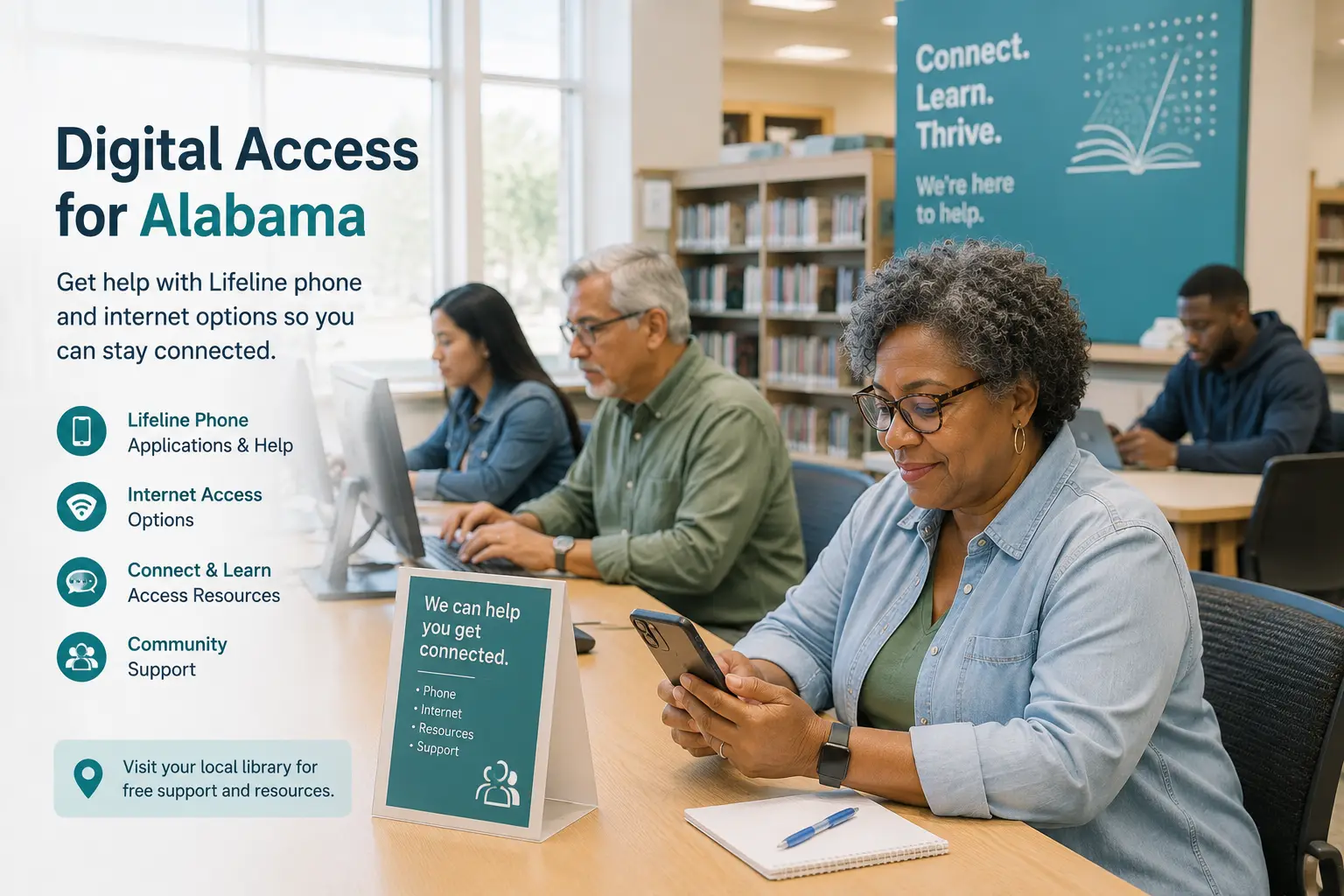
ADECA's Digital Expansion work, Alabama public libraries, local community action agencies, and assistive technology resources can help residents who need internet access, application help, or device-related guidance. Public libraries are especially handy if you need a computer, printer, Wi-Fi, or just a safe and quiet place to review your documents before submitting anything.
Urban searches
In Birmingham, Montgomery, Huntsville, Mobile, and Tuscaloosa, you may see more providers, but phone model promises still need careful review.
Rural searches
In rural counties, check network coverage, shipping terms, address matching, and whether the provider accepts PO Box or rural route documentation.
Disability access
Alabama residents with disabilities may also check STAR or assistive technology resources for device access, equipment reuse, and technology guidance.
Safe Path to Check Lifeline iPhone Options in Alabama
Go through this path before trusting any free iPhone claim. It keeps the whole process focused on eligibility, official checks, provider comparison, and keeping your personal data safe.
Documents You May Need in Alabama
Do not upload documents to unknown websites. Stick to official Lifeline, National Verifier, or trusted provider channels only. Our how to apply guide walks through the steps in more detail.
| Document type | Examples | Alabama issue to check |
|---|---|---|
| Identity | Driver license, state ID, passport, or other accepted proof | Name must match the Lifeline application |
| Address | Utility bill, lease, mortgage statement, official letter | Rural route, PO Box, or recent move can cause mismatch problems |
| Benefit proof | Food Assistance, Medicaid, SSI, housing, veterans benefit letter | Use current proof that shows your name and active participation |
| Income proof | Pay stubs, tax return, unemployment, benefits statement | Income proof should be current and match household details |
| Household worksheet | Required if another adult at your address has Lifeline or shares an address | Apartment, shared housing, family property, and multi-unit homes may need extra clarity |
| Tribal documents | Accepted Tribal program or residence documents, where applicable | Use official Lifeline guidance for Tribal eligibility and location rules |
Apply Now in Alabama, Safe Guided Path
This section is not a government form and does not collect sensitive information. Use it as a checklist before you apply through an official Lifeline route or a trusted provider.
Eligibility pre-check
Do you receive Alabama Food Assistance, Alabama Medicaid, SSI, housing assistance, veterans benefits, or meet income rules?
Document readiness
Check that your name, address, benefit proof, and household details all match before submitting anything.
Provider ZIP check
Search by ZIP code. Alabama providers can vary between cities, counties, rural routes, and coastal areas.
Device expectation check
Do not apply just because you spotted the word "iPhone." Confirm whether the offer is an iPhone, Android, 5G phone, refurbished phone, discounted upgrade, or service-only option. Approval and iPhone stock are not guaranteed.
Provider Availability and ZIP Code Checks in Alabama
Your ZIP code matters more than the state name alone. Two Alabama residents can both qualify for Lifeline and still pull up completely different provider options. Someone in Huntsville may see a different list than someone in Selma, Eufaula, Jasper, Atmore, or a Gulf Coast community.
Before applying, compare monthly service, talk and text terms, data, hotspot rules, activation costs, shipping charges, device condition, iPhone stock, Android backup options, network coverage, and recertification rules. If a provider page mentions a free iPhone 13 or another specific model, read the fine print before entering any personal information.
Our providers guide is a solid starting point. If you want to compare known Lifeline-related companies, you can also check provider-specific pages like AirTalk Wireless or Assurance Wireless, but always confirm current Alabama availability by ZIP code.
What To Do If No iPhone Offer Is Available
If no iPhone offer shows up in your Alabama ZIP code, you still have useful options. Getting reliable phone service comes first. Device preference comes second.
- Accept a Lifeline phone or service first if staying connected is urgent.
- Compare Android smartphone offers instead of waiting around for an iPhone promotion.
- Check free 5G government phone options if 5G service matters in your area.
- Consider a low-cost refurbished iPhone separately if you specifically need iOS.
- Use public library Wi-Fi or computers while your application is pending.
- Check Alabama broadband and digital access resources for local connectivity support.
- Contact a community action agency if you need help with utilities, documents, or local support.
- Check STAR assistive technology resources if your need is disability-related.
- Avoid paying suspicious approval fees to unlock a fake iPhone offer.
Best practical move
If you qualify, choose the safest available Lifeline service option first. Then compare upgrade or refurbished iPhone options only after you fully understand the service terms.
Special Guidance for Alabama Residents
Seniors
Alabama seniors may qualify through Medicaid, SSI, income, veterans benefits, or other accepted routes. Keep the process simple: check eligibility, gather proof, and compare easy-to-use phone options. See our senior phone guide.
Families with EBT
Families receiving Alabama Food Assistance can use current benefit proof to support Lifeline eligibility. Do not give your EBT PIN to anyone promising a free iPhone.
Medicaid households
Medicaid can help prove eligibility, but the applicant name and Medicaid document must match the Lifeline application.
Rural residents
Rural Alabama residents should check coverage maps, shipping addresses, PO Box limits, and whether the provider can actually serve their exact home ZIP code.
Veterans
Veterans Pension or Survivors Benefit can be a Lifeline eligibility route. A current benefit letter may be needed if automatic verification does not go through.
People with disabilities
Residents with disability-related technology needs may also check assistive technology resources in Alabama while comparing phone options.
Scam Warnings for Alabama Residents
Scammers go after people searching for free iPhones, EBT phone offers, Medicaid phones, and ACP replacement programs. Watch out for anything that sounds too easy or too good to be true.
- "Guaranteed free iPhone today" claims.
- Fake government logos or fake approval stamps.
- Fake ACP claims after ACP ended.
- Requests for your EBT PIN.
- Requests for bank cards, debit cards, or payment to unlock approval.
- Social media-only sellers with no official provider website.
- Fake tracking numbers before real approval.
- Specific iPhone model guarantees without any terms.
- WhatsApp or Telegram-only agents asking for documents.
- Copied provider names, misspelled domains, or hidden contact information.
Helpful Checklist Before You Apply
- Confirm benefit or income eligibility.
- Check the one-per-household rule.
- Gather current documents.
- Match your name and address across documents.
- Search providers by Alabama ZIP code.
- Read device terms before applying.
- Check iPhone vs Android availability.
- Protect your EBT PIN and sensitive information.
- Save confirmation emails or application IDs.
- Complete recertification if required later.
FAQs About Free Government iPhones in Alabama
Can I get a free government iPhone in Alabama?
Maybe, but it is not guaranteed. Alabama residents may qualify for Lifeline service through benefits or income, but iPhone availability depends on provider offers, ZIP code, device stock, fees, and provider rules.
Does Alabama EBT qualify me for a free iPhone?
Alabama Food Assistance can help prove Lifeline eligibility, but it does not guarantee a free iPhone. It may help you qualify for service support or a provider phone offer.
Can Alabama Medicaid help me get a free phone?
Yes, Alabama Medicaid can be a Lifeline eligibility route. The actual phone offer depends on the provider serving your ZIP code and the device terms available at the time.
Is Lifeline still active in Alabama?
Yes. Lifeline is still active. ACP ended, and households stopped receiving ACP discounts after June 1, 2024.
Did ACP replace Lifeline or give free iPhones?
No. ACP was a separate internet discount program and it has ended. Lifeline remains active, but it mainly helps with phone or internet service costs, not guaranteed iPhones.
Are iPhones guaranteed through Alabama Lifeline providers?
No. iPhones are provider-specific and may be refurbished, limited stock, promotional, discounted, or simply unavailable. Android phones are often more common.
What if only Android phones are available in my Alabama ZIP code?
If staying connected is the priority, consider the Android or service option first. You can compare 5G phone options or buy a low-cost refurbished iPhone separately if needed.
Can Alabama seniors get a free iPhone?
Alabama seniors may qualify through Medicaid, SSI, income, veterans benefits, or another accepted Lifeline route. A specific iPhone still depends on what the provider has available.
Do rural Alabama residents have fewer provider choices?
They may. Rural areas, small towns, and some Black Belt, Wiregrass, Gulf Coast, and north Alabama communities may see fewer options than larger metro areas.
Will Birmingham and Mobile have the same phone offers?
Not always. Provider results can vary by ZIP code even inside the same state, so Birmingham, Mobile, Huntsville, Montgomery, and smaller towns may show very different offers.
What documents should I prepare before applying?
Prepare proof of identity, address, benefit participation or income, and household details if needed. Make sure your name and address match across all documents.
How do I avoid Alabama free iPhone scams?
Avoid anyone asking for your EBT PIN, bank card, upfront approval fee, or documents through social media messages. Use official Lifeline or trusted provider channels only.
Final Helpful Summary
Alabama residents can safely check free or discounted smartphone options through Lifeline, especially those who receive Food Assistance, Medicaid, SSI, housing assistance, veterans benefits, or meet income rules. The smartest next step is to verify eligibility, search providers by ZIP code, compare device terms carefully, and protect your personal information.
A free iPhone is only possible when a provider has an eligible offer available for your location. It is not guaranteed by the federal government, Alabama DHR, Alabama Medicaid, FCC, USAC, or this website.
External Resources
Use these official or trusted resources for Alabama benefit checks, Lifeline rules, provider searches, and local access support.